Hello! Welcome to my blog wherein delicacies, culture and heritage, tourist destinations and history will be flexed. But first, let me introduce myself.
I am Louise, 17 years old, from Argao, Cebu. I am currently in 12th grade taking up Science, Technology, Engineering and Mathematics (STEM) at Sibonga National High School.
I decided to create this blog since I love adventures and travelling is one of my hobbies. Also, this is to showcase the different heritage, culture and history of different localities in Cebu.
Nowadays,
noise pollution is recognized as the major problem in urban areas. Impatience,
over accelerating, abiding traffic rules and etc. are some attitudes which can
aggravate honking. Noise levels above 55 dB are considered important as they
disturb the comfort of hearing. In addition, traffic noise causes physiological
and cognitive alterations, sleep disturbances, psychological symptoms and etc.
It has a significant effect on quality of life even when it is not loud enough
to cause medical or psychological symptoms. Other discomfort subsequent to
noise exposure are temporary or permanent loss of hearing, stress and
irritability.
The
students and teachers develop their activities in the school. However, the
noise can interfere with the teaching, learning process and the course of educational
activities. Many studies conducted abroad on noise pollution in schools have
revealed the negative effects of noise on learning and teaching (Choi &
McPherson, 2005; Grebennikov, 2006; Jewell, 1980; Skarlatos & Manatakis,
2003; Shield & Dockrell, 2008).
Ali
et al. (2014) conducted a study on the effects of school noise on learning
achievement and concluded that there is strong relationship between noise
levels and the percentage of highly annoyed students; in fact, 57% of
respondents said that the noise from vehicles obstructed their learning
environment. According to Dockrell and Shield (2006), noise causes difficulty
for children to concentrate on lessons by preventing verbal communications and
decreasing the learning experience and problem solving skills of children.
The
World Health Organization WHO, (2015) reported that noise- induced
complications hinder the teacher-student communication and eventually affect
the learning process on young children. Constant noise exposure in classrooms can
obstruct learning. Children who are exposed to noisy learning environments have
lower assessment scores on standard tests. When speech participation is tackled,
as the great task of knowledge transmission depends on it, it must be clear,
harmonious and intelligible and beyond all any competitive noise, the teacher’s
voice is another point of interest, otherwise the students will not follow the
teaching.
Considering
these harmful effects, the group aims to conduct a program that will eradicate
its causes and in turn help address the concern that will preserve and maintain
the standard state of classes going on in school.
The
program intended to implement by the group is called Smart Honking since among
the solutions imposed about unnecessary honking is creating silence zones near
the hospitals and educational institutions in the studied places. This being an
existing rule to reduce the disturbance to hospitals and educational
institutions has also been able to reduce the noise levels in surrounding
areas.
Smart
Honking could be implemented at any institution or establishment that is
disturbed by unnecessary noise produced by the streets along it. For example,
in Sibonga National High School, a school located along the national road and a
busy street, during normal school days, classes held at classrooms located
along the roads experience occasional street noise disturbance. This causes
interruptions between the teachers and the students’ discussion, distraction to
the students answering an exam and other negative effects mentioned earlier.
In
relation to the studied literature on creating silent zones, our group plans to
put effective road signages on streets along the school margin which aims to
provide instructions to drivers regarding the concern. While the signage may
not be official, it does cite the official California vehicle code, section
27001 of which declares that horns should only be used by drivers if
“reasonably necessary” to ensure their safety. To guarantee
effectivity, the group would like to request the municipality to consider
unnecessary honking and noise creation near schools as a road violation and
impose fine to whoever are caught doing such. The group would also want to have
government enforcers facilitate the streets for better conduct of the road
operation.
In
addition, the group also aim to craft infographic posters presenting the
harmful effects of noise pollutants, specifically honking, to the people
experiencing it, especially those at the school, and the whole learning exchange
going on. Moreover, the group plans to create a WordPress blogsite and a
Facebook and Twitter page to have our created social campaign and digital infographic
posters be posted on. Our group have seen this approach to help achieve our
goal for the reason that these online platforms are populated enough with users
who may help in spreading awareness to the mass which the group visions to
reach our main target, the drivers.
The
group will be requiring a month or two in developing our program that includes
crafting of signages, creation of infographic posters, social campaigns, blogs
and posts. Since the physical products the group will be creating are signages
and infographic posters, our expenses may include printing fees and
construction materials such as poles and boards on which we will be posting our
product into. We will only be acquiring free services readily offered by
Facebook, Twitter and WordPress. Therefore, our online campaign cost no
expensive charges at all, though we still need to purchase internet packages.
As soon as our permission is granted and all the needed materials are ready,
the road operation and online campaign will be started.
If
ever you have any questions and concerns regarding our program, please feel
free to contact us at smarthonking@gmail.com.
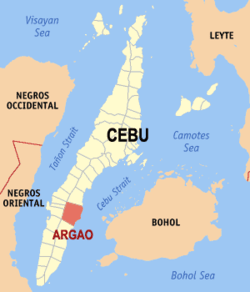
The municipality of Argao is located in the southeast of the province of Cebu, 68 km (42 mi) from Cebu City, and a 2nd district of the province. It is surrounded to the north by the town of Sibonga, tthe west are the towns of Ronda, Alcantara and Moalboal, to the east is Cebu Strait while to the south is the town of Dalaguete. Argao is composed of 45 barangays and now acknowledged as a first class municipality.
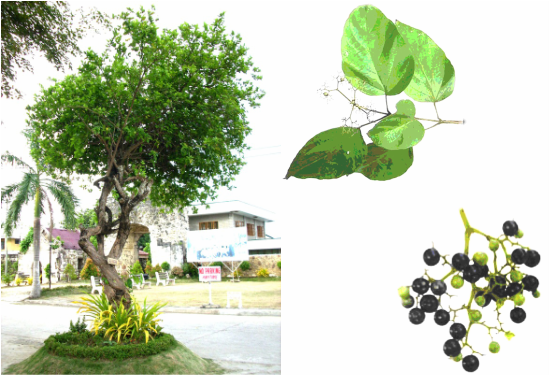
Argao became a pueblo in 1608 and is considered as one of the oldest towns in Cebu. But wait, where did it obtained its name? How? Well, it came from the plant “Sali-argao,” “abgaw,” “alagaw” or scientifically known as Premna odorata. But what happened to the word Sali? Let us all find out.
According to the legends, there were three white men who came to the town for they were lost. While finding their way back, they happened to see a fisherman. The foreigners asked the latter on what is the name of the town using their language. Since the local fisherman could not understand the foreigners for he only knew Sinugbuanong Bisaya, he thought that the 3 white men were asking for the name of the tree which is the since they were under the said plant. He then answered, “Sali-argaw” unfortunately, the foreigners did not clearly hear what the fisherman said because of the waves that were crashing down ashore, the world they could merely hear is “Argao.”and whenever those 3 white men visits the town, they would tell their colleagues its name, “Argao.”
The second reason about its name is that the town’s shorelines were filled with the said plant and it’s very common to the locality. Furthermore, the name was also used by the traders from various provinces from then on, the town became known as Argao.
Sali-argaw
Structures in the Cabecera
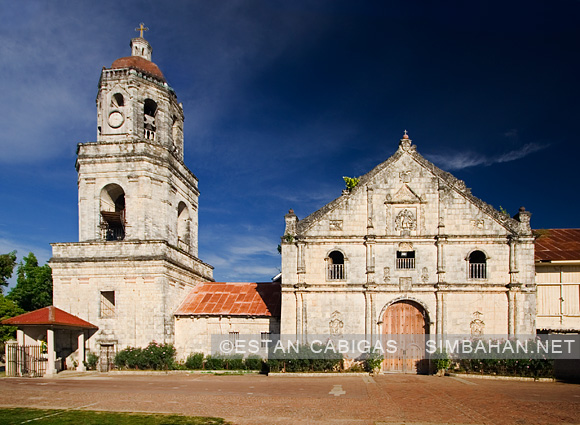
St. Michael the Archangel Church
It is an Agustinian Chruch. The construction of this church started in 1734 and finished in 1788. It took 54 years for the Argaoanons to build this structure since during that time, pirates often try to attack the town to get spices and maidens to make them slaves or wives. To protect the maidens, they would keep them inside the church while the men fight against the pirates. It is made up of lime stones, egg white, law-at, and togas woods. The facade is divided into 9 pillars each pillars have significant sculptures. It is a cross-like church when viewed from aerial shot.
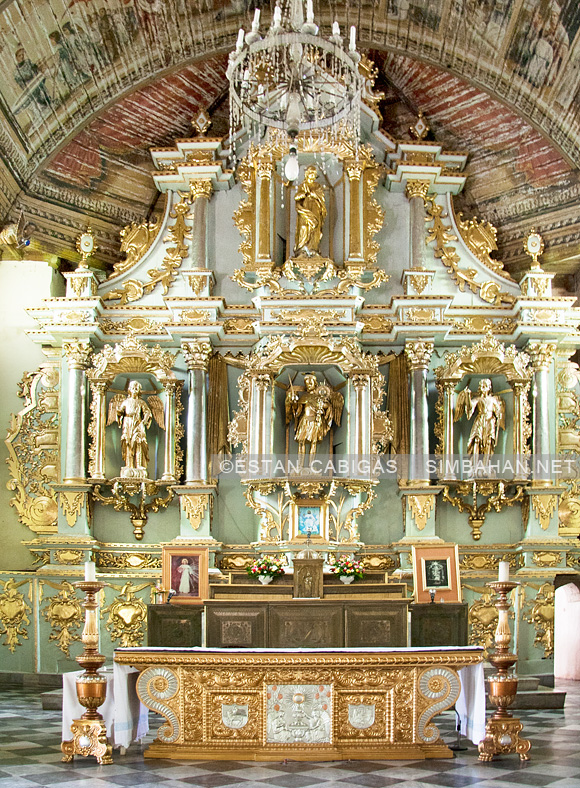
The ceiling near the altar was painted by Raymundo Francia and was later on continued by Canoto Avila. Paintings depicts the life of the angels and archangels, plus several Biblical passages. The altar has 5 retablos: one retablo mayor contaning the life-size statues of the three archangels namely, St. Michael, St. Raphael and St. Gabriel and also the statue of Mama Mary. The remaining 4 retablos are the retablo menor.
Chapel of the Dead/Capella Mortuario
It was where the corpse of some Argaoanons are held for its funeral. It has one service coffin for the dead. Like the church, it has significant sculptures that depict the beliefs of the Roman Catholics. The left side of the chapel has a carving of dead ivy plant which represents hell while its right side represents heaven, having an alive ivy plant. Above its door is a sculpture of hourglass, skull, wings(of the devil and an angel) and a circle. This means that each on of us has our own time to die and we will go either heaven or hell. left hell – dead ivy plant, right heaven – alive ivy plant. Above it is the sculpture of St. Michael carrying a baby representing the Argaoanons which also means that St. Micheal is saving the souls of the people from hell. Aside from being used as a chapel of the dead, it served as leprosarium when the townspeople was suffering from leprosy during the American Period.
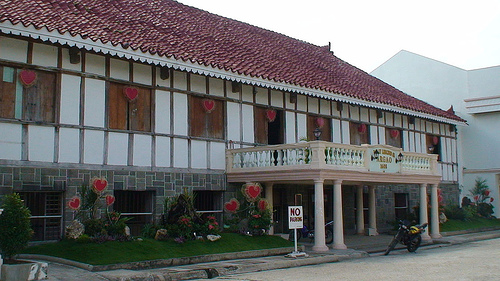
Municipal Hall or the Casa Real
Ever wondered why is it called Casa Real? Well, Casa means “house” while Real means “royal.” Typically, it is where the VIPs are welcomed or used to stay. Similar to the previous structures mentioned. it is made of lime stones, law-at, egg white and woods such as togas. It is 90% wood, 5% stones and 5% metal. The nails used are 99% woods and 1% metal. It contained 20 big wood pillars, making it earthquake proof. It is Chinese, Filipino, Mexican and Spanish inspired structure. The edges of its roof are identical to the Chinese temples, making it Chinese inspired; Filipino because it is similar to the bahay-kubo, a two-storey house; Mexican for its roof design; lastly Spanish because of its large windows. The large windows are for passive cooling. The roof tiles are clay tiles and have different sizes. Why is that? It is because according to the myths, the clay tiles are molded from the laps of the maidens is town that’s why some tiles are small and some tiles are larger.
During the American period, the 2nd floor served as voting area while the 1st floor served as jail during WWII.
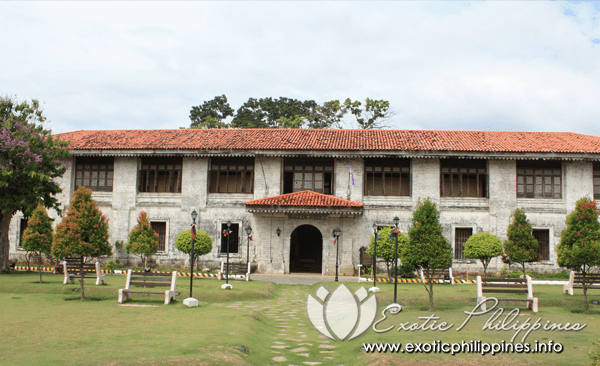
Hall of Justice
This structure Colegios de los Ninos (school for boys) during the Spanish Era, tobacco plottery during American Period, barracks during WWII, Star theater that plays black and white movies every Fridays to Sunday afternoons, Argao Parents-Teachers Association building, first Argao Central Elementary School building, where former Chief Justice Hilario Davide Sr. graduated in elementary, then later became the Hall of Justice. The materials used in building this is similar to the Casa Real. The windows are made of woods and capiz shell. The left side of the building is the municipal trial court while the right wing is regional trial court.
Argao Unity Plaza
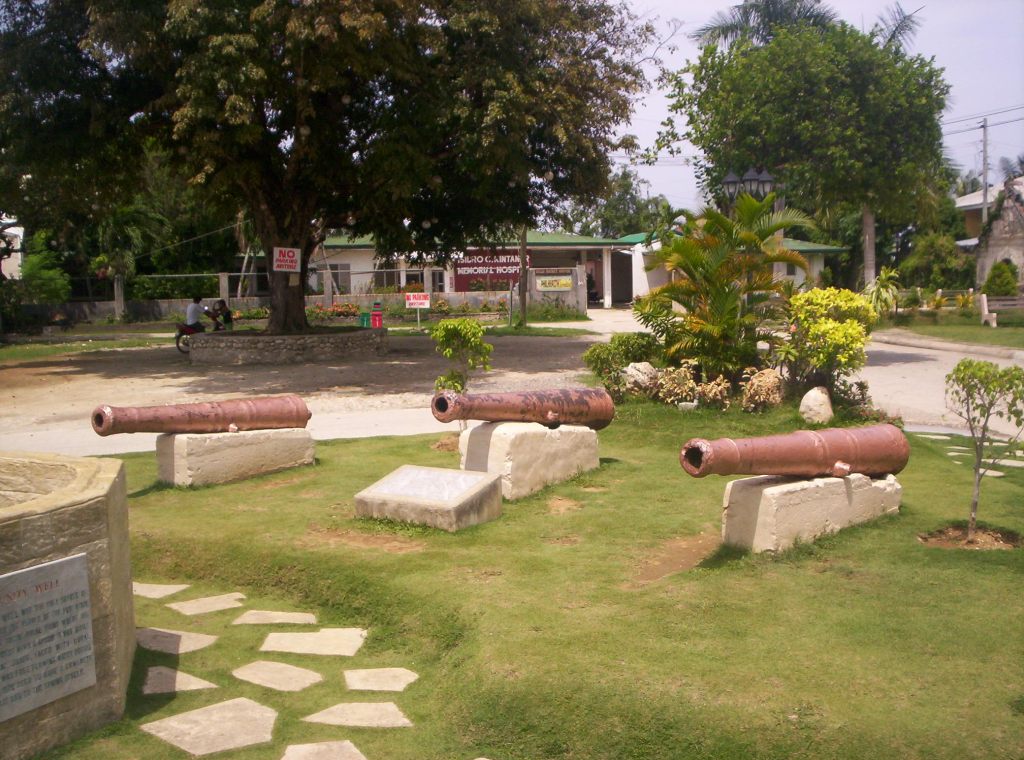
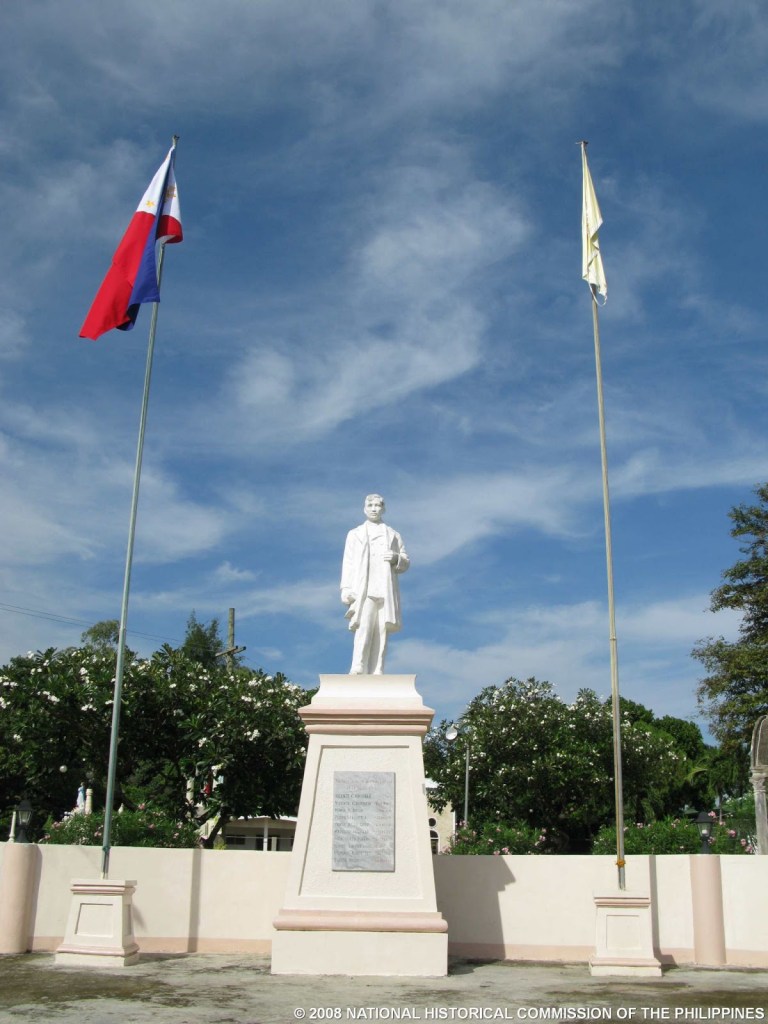
The town’s unity plaza is considered as one of the most beautiful plazas in Visayas. It is also the first free-wifi zone in the plazas of Cebu. It has 5 important itineraries: the 3 old cannons, well, old telecom post, Narra tree and the Jose Rizal Monument.
3 Old Cannons
These 3 cannons were originally placed near the baluarte and served as first line of defense. These cannons are still functional as of today and are still used every Independence Day and important events in the Cabecera.
Well Functioned as a source of water in Poblacion but was later on contaminated, causing leprosy. From then on, it was never used. In recent years, it was used as design in the park and displays different colors at night.
Old Telecom Post It was built in 1927 and was placed near the Casa Real so that the townspeople could send message from the people from afar. Each syllable is worth 2PHP since there is no modern technology that time.
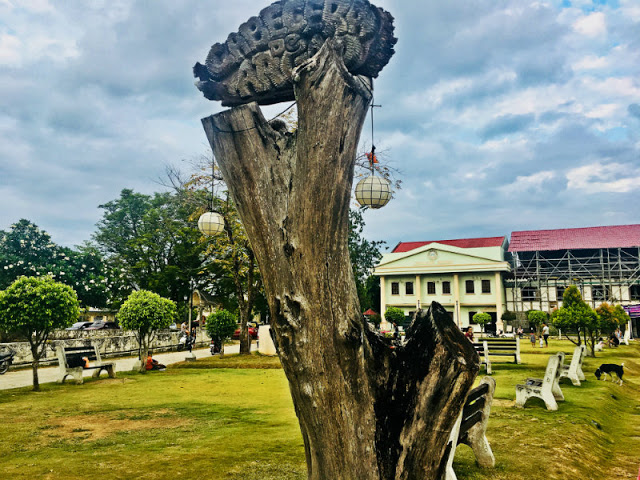
Old Narra Tree
Old Narra Tree, also called the Independence Tree This narra tree was planted during the first Independence day of the Philippines from the Spanish colonization in 1898 by the mayor of the town. It was cut for safety purposes.
Jose Rizal Monument
The sculpture was originally placed at the center of the unity plaza, facing the Casa Real. It is also just from the bust but later on transferred, facing the Hall of Justice for Jose Rizal died seeking for justice and was made into whole body. Carved under Pepe’s sculpture are the names of the previous mayors of Argao that passed away.
Delicacies
La Torta de Argao
Argao’s Torta: Magkadugay, Magkalami!
One of the famous delicacies in Argao is the Torta. It is made of flour, sugar, egg yolks, lard and tuba (sweet, fresh coconut sap or wine), the Torta of Argao has its origins way back to the Spanish colonial era of the Philippines. Argaoanons used the tuba as it is more available than yeast during that time. The tuba also works to lengthen the shelf life of La Torta.
This delicacy from Argao is still considered as the best although torta are available in many bakeshops in Cebu. It is their famous delicacy that they are so proud. In fact, Argao’s previous Pitlagong Festival was replaced in 2011 by La Torta Festival, a feast mainly dedicated to its famous delicacy.
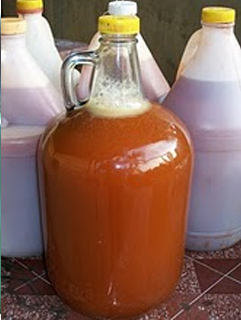
Tuba
Homemade Tuba
Also known as coconut wine. People in Jampang have established themselves as tubá manufacturers for years of acquired skill and the extracting of this alcoholic beverage. The classic or old-school version that is practically tubá, inspired Argao’s former annual celebration, the Pitlagong Festival that was later on changed to La Torta Festival.
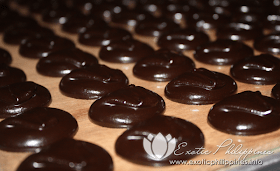
Tablea
Tablea
Tsokolate tablea, or just plain tableato most Filipinos, can be literally translated to “chocolate tablets” in English, because that is exactly what it is. Dried local cocoa beans, are roasted for a few hours before being ground to a rich, chocolate-y paste. The tablea itself is made by adding sugar to the paste and shaping it into balls or tablets, hence the name.
That would be all for this post and I hope that you enjoyed and learned something from this virtual travel. See you next time! -Loysie




 EINSTEIN - Travel